“I want to make friends... but I don’t know how.” This heartfelt sentence, shared by a 9-year-old with autism during a therapy session at Urjasvini, captures the silent struggle of many neurodiverse children. At Urjasvini Child Development Centre in Indore, we meet children who are bright, creative, and full of potential — yet face challenges …

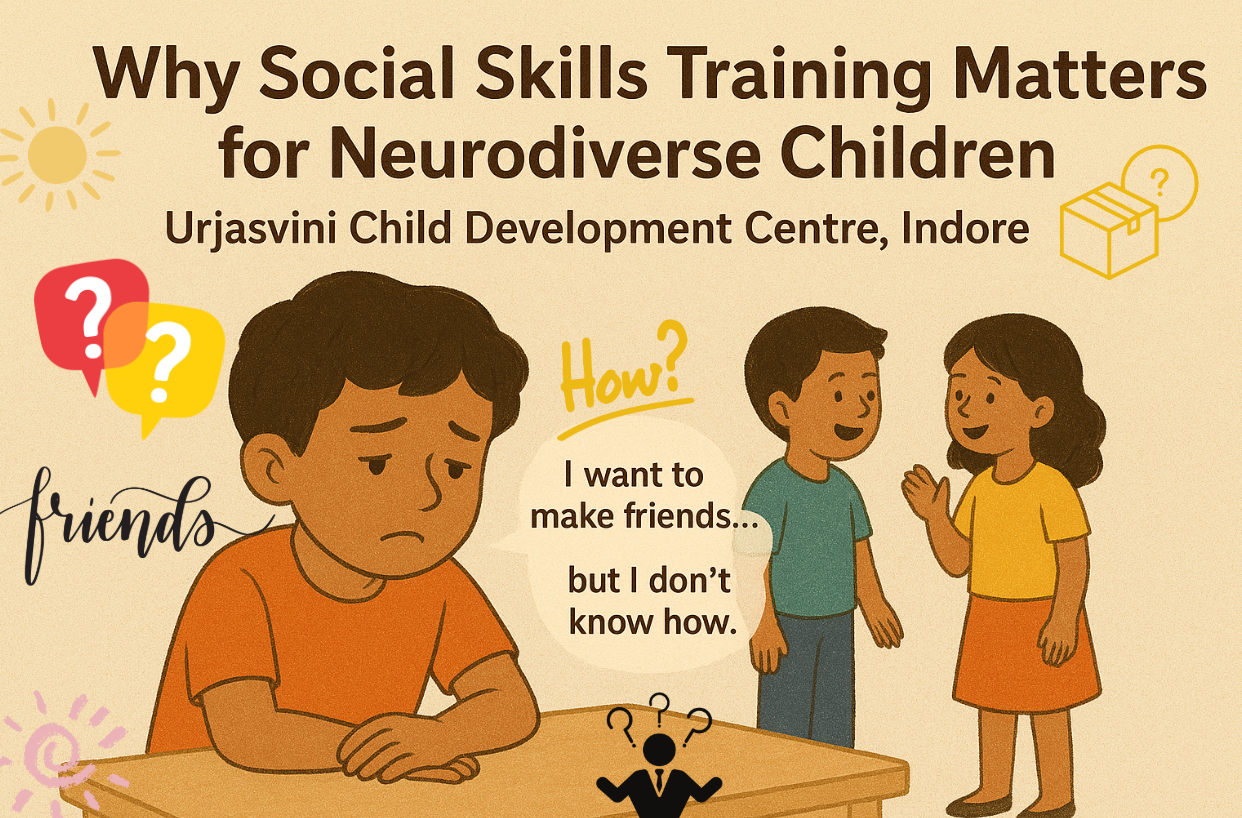
“I want to make friends… but I don’t know how.”
This heartfelt sentence, shared by a 9-year-old with autism during a therapy session at Urjasvini, captures the silent struggle of many neurodiverse children.
At Urjasvini Child Development Centre in Indore, we meet children who are bright, creative, and full of potential — yet face challenges in forming friendships, participating in group activities, or navigating everyday social situations. For children with childhood disorders such as Autism Spectrum Disorder (ASD), ADHD, or Social Communication Disorder, these difficulties can feel overwhelming.
Without the right guidance, such struggles can affect emotional health, academic performance, and self-esteem. That’s why our counsellor therapists and special educators focus on building essential social skills through structured, evidence-based programs.
Arnav, an imaginative 8-year-old, loved dinosaurs, puzzles, and painting. Yet at school, he was labeled “aloof” and “disruptive.” Classmates were unsure why he stood too close or repeated the same questions.
Meet Arnav – A Journey of Growth
His parents brought him to Urjasvini seeking answers. Through our behaviour counselling and Social Skills Training, Arnav learned:
- How to start and maintain conversations
- How to read facial expressions and emotions
- When to listen, when to speak, and how to wait patiently
Today, Arnav is part of the school science club, shares jokes with friends, and carries himself with confidence.
Why Social Skills Training Is Essential for Neurodiverse Children
Children with childhood disorders like ASD, ADHD, and Learning Disabilities may face:
- Difficulty reading body language or tone of voice
- Trouble understanding unspoken social rules
- Frustration in group settings
- Challenges in perspective-taking and empathy
These hurdles can lead to:
- Peer rejection or loneliness
- Conflicts with teachers or adults
- Emotional outbursts in social situations
- Low self-confidence and anxiety
Social skills are not “optional extras” — they are foundational life tools.
The Science Behind Social Skills Training
A 2019 meta-analysis in the Journal of Autism and Developmental Disorders found that targeted social skills programs significantly improve peer interaction, emotional awareness, and conflict resolution.
Another study in Child Psychiatry & Human Development showed that outcomes improve when parents and therapists work together — a core principle we follow at Urjasvini.
Our Social Skills Training Approach at Urjasvini
We use a structured, child-sensitive model, combining behaviour counselling with hands-on practice:
- Age-specific peer groups (5–8 years, 9–12 years, Teens)
- Safe, encouraging environments to practice without fear
- Sessions designed and supervised by our expert counsellor therapists and special educators
Activities include:
- Role-play and real-life scenarios
- Emotion recognition games using visuals and stories
- Turn-taking and listening games
- Social stories and comic strips for reflection
- Peer interaction under therapist guidance
Every child’s learning style is unique — we adapt to meet them where they are.
The Parent Partnership
Social growth accelerates when therapy aligns with home and school. We:
- Provide feedback after each session
- Offer modelling sessions for parents
- Assign practical tasks to apply skills in daily life
Your involvement is a vital part of your child’s success.
Signs Your Child May Need Social Skills Support
- Difficulty making or keeping friends
- Struggles to understand jokes, sarcasm, or emotions
- Misinterprets tone or body language
- Feels anxious in group settings
- Prefers adult company or solitary play
If these signs persist for more than six months, early intervention can make a life-changing difference
Book a Consultation
It’s easy and free!